
Quick answer
Instagram does not pass to your family the way a bank account does. The platform will memorialize or delete an account on request — but it will not hand over the login, the messages, or full control. If your account is a business asset, it needs to be treated like one: with shared access, a password manager, and a documented handover plan — while you are still here.
- Set up a legacy contact now—Instagram won't grant family full access after you're gone
- Document shared login credentials and handover instructions if Instagram generates business income
- Understand: memorialization preserves the account but keeps family out of messages and control
For a long time, Instagram felt like something light and almost trivial. Photos, stories, messages, reactions, comments. Not an apartment, not a bank account, not a stack of documents locked in a safe. Just another app on your phone.
But the more you look into digital inheritance, the clearer it becomes that these "simple" things often create the most painful questions for a family later on. At least with money, people generally know where to go. There is a bank, a notary, procedures, and statements. But what exactly happens to the popular Instagram account of a person who is no longer here is far less obvious.
What Instagram Actually Allows
Once you start looking more closely, you discover something uncomfortable. Instagram does not pass an account to the family the way many people assume. You cannot simply write to support, prove that you are the son, daughter, or spouse, and receive the login, the archive, the messages, and full control. For relatives on the outside, the system leaves two options.
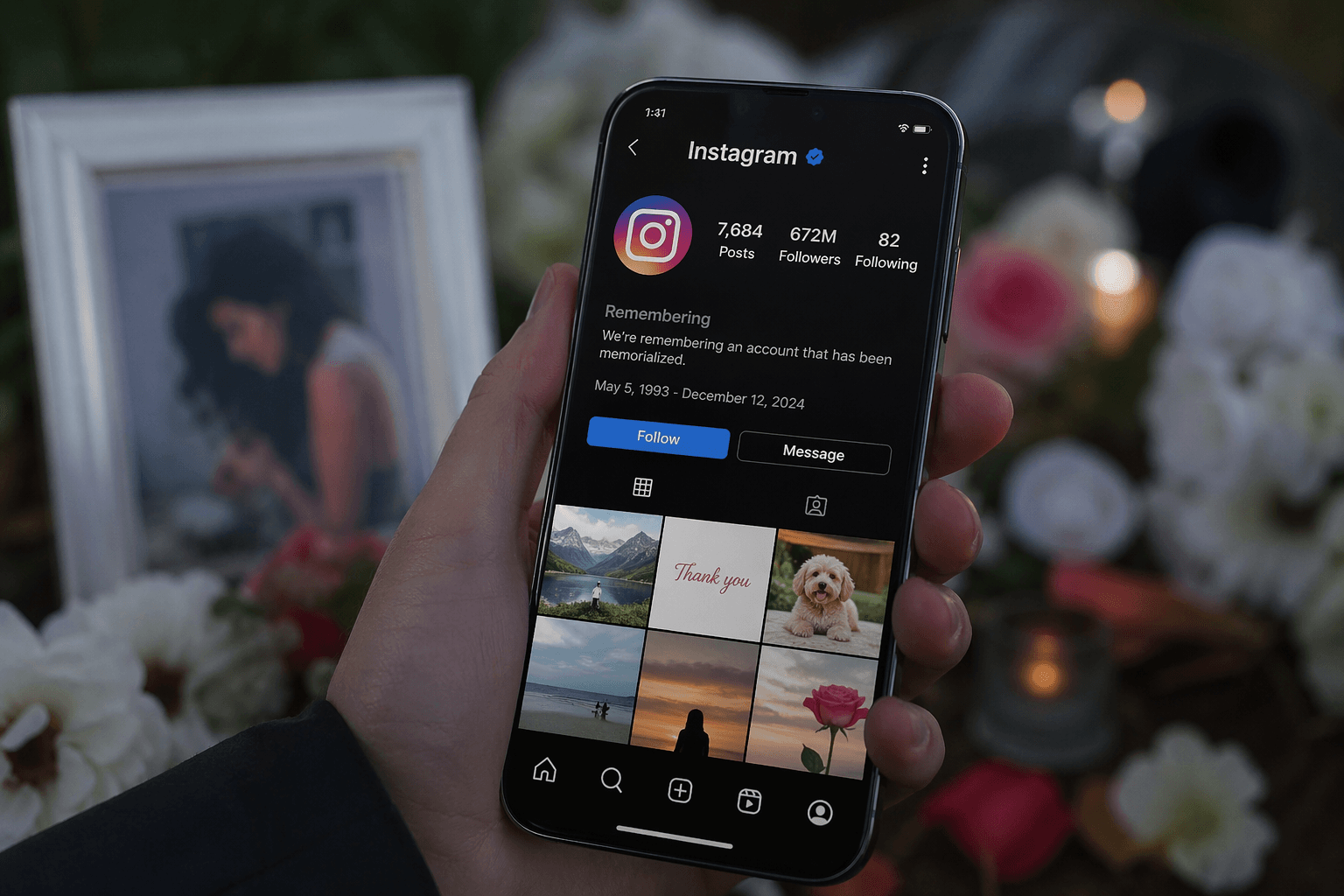
The account can be memorialized — preserved as a memorial page. Or a request can be submitted to have it deleted.
For memorialization, Instagram asks for proof of passing, such as a link to an obituary or news article. For deletion, it usually requires documents showing legal authority to act on behalf of the deceased. But in neither case does the family receive full access to the account itself or to private messages. That is Meta's position, tied to the privacy of the person who is gone.
The Account Stays — But the Family Can't Enter
This is where the most uncomfortable part begins. The account does not disappear. It stays online. The photos remain, the captions remain, the messages remain, the contacts remain — and sometimes a whole multi-year record of a person's life remains there, too.
Sometimes, part of a business remains there as well. And this is what many people still underestimate.
We are used to thinking of Instagram as a showcase or a distraction, but for a long time now, it has also been a working tool. For some people, orders come through it. For others, it is where sponsorships happen. For some, it is a personal brand that has supported them for years. For others, an entire small business depends on direct messages, stories, and a steady stream of inquiries.
And if that kind of account is left behind without its owner, the situation becomes especially difficult. The asset is still there, the audience is still there — but no one can truly use it.
The Scale of What Is at Stake
This is no longer a small or personal issue. In September 2025, Meta said that Instagram had reached 3 billion monthly active users. We are not talking about just a big social platform. We are talking about one of the largest digital environments in the world. And if we are going to talk seriously about digital inheritance, treating Instagram as something minor is no longer possible. Too much attention, money, memory, and value now lives there.
What You Can Set Up While You Are Still Here
The account owner has more options while alive than the family has afterward. Instagram now allows you to decide in advance whether the account should be memorialized or deleted, and to appoint a legacy contact.
But here it is important not to fall into the illusion that this solves everything.
A legacy contact on Instagram does not become the new owner of the account. This is not a way to "inherit" the profile. That person cannot log in as you, read Direct messages, post on your behalf, or freely manage everything inside the account. Their powers are limited — which is exactly why a memorialized profile cannot really be treated as a working archive or a normal business asset.
When Instagram Is a Business Tool
This is where the core problem sits. For the platform, Instagram is a profile. For the person behind it, it may be an asset. Not only an emotional one, but a financial one.
A person can spend years building an audience, investing money in promotion, growing a reputation, producing content, paying for ads, arranging collaborations, building funnels, and shaping a personal or corporate brand. A person can genuinely earn through Instagram.
But if access to that account is tied to a single individual — and that individual suddenly is no longer here — the platform will not simply allow the account to be transferred, the way a domain or a business email account might be. You end up with a very uncomfortable reality: the account is still there, but it is effectively frozen for the family or the team.
This is especially important for people who use Instagram not as a photo album but as part of their work. Because then the issue is no longer whether the account should be deleted or kept as a memorial. The issue becomes how not to lose a revenue stream, advertising relationships, client messages, audience trust, and the money already invested into growth.
The Locked Door Problem
If no one has thought in advance about how access is organized — who knows the backup email, where the passwords are stored, whether a password manager is in place, whether the team has any kind of plan — then the family and the partners may find themselves standing in front of a locked door.
From the outside, there will still be a polished, successful, high-value account. But no one will be able to do anything with it.
What is most striking is not even that Meta protects privacy aggressively. The platform's logic is understandable. What is more unsettling is something else. People pour real years, real money, and real attention into Instagram — but from an inheritance perspective, this asset can be far weaker than they imagine. It is a poor fit for improvisation. It cannot be calmly sorted out later.
Two Very Different Situations
It is important to separate them clearly.
If Instagram is simply a personal memory archive for you, then at the very least you should decide whether you want the account preserved as a memorial or deleted after you are gone. That alone already matters.
If Instagram is a business tool for you, then it has to be treated not as a sentimental page but as a business asset that should not depend entirely on one person. In that case, the question is not only about memory — it is about operational resilience.
- Who else has access?
- How does handover work?
- What happens if the owner is no longer here not in ten years, but tomorrow morning?
- Who continues responding to clients?
- Who sees important messages?
- Who even understands what is going on?
What to Do Now
The biggest mistake here, as with almost everything in digital inheritance, is relying on "later." People assume their loved ones will figure it out. But Instagram is exactly the kind of place where later often means too late.
Support will not hand over private messages. It will not provide the login. It will not unlock full control. The audience will not somehow move to the heirs on its own.
That is why the question "what happens to my Instagram after I am gone?" is no longer just a curiosity. It is a practical question about money, memory, privacy, and control.
Inheritance used to be tangible — an apartment, a car, bank papers, a family photo album. Today, for many people, a significant part of life sits in a phone, in the cloud, and on social platforms. Instagram has become one of the strongest and at the same time one of the most vulnerable parts of digital life. It can be a business storefront, a memory archive, and a communication channel all at once — yet a genuinely human handover scenario after someone is gone is still mostly missing.
And perhaps the harshest conclusion is very simple. Your Instagram will not disappear after you. The real question is whether it will remain a beautiful locked display case that no one can enter — or whether you will decide in advance what should happen to it. Because if you do not make that decision yourself, the system will make it for you. And the system does not know whether this was just a photo profile or an asset into which you poured years of your life and serious money.
Related reading


